





"In 1239 at that time thirteen-year-old duke of Sandomierz, and then also duke of Cracow, Bolesław V, son of the murdered in 1227 Leszek the White, married - daughter of king Bela IV - Kunegunda. In this way involved with the powerful house of Arpad prevailing in Hungary. His bride called diminutively Kinga, was only five years. Legend speaks of a hot heart of duke, who fell in love at first sight. and gave his future wife fiery emotion. But she, so that marry Bolesław she fled from Hungary in a travel crate. It is true, that for the first time they met in Wojnicz and their marriage was entered in the dynastic plans of polish Piasts and Magyar Arpad. Then Poland was a falling country, and the former splendor of Piasts went away into oblivion. Marriage with a Hungarian princess was for Bolesław a chance to restore the prestige and size of family and the country broken into quaters. In turn Magyar Arpad hoped to decrease after Piasts, achievment of the Polish throne and the creation in Central Europe powerful, federal state. Kinga after arriving to Poland remaind at the manor in Cracow. In 1239 due to the young age of princes took place engagement, while the real wedding seven years later. That was already after the terrible Tatar invasion, who in 1241 devastated both Poland and Hungary. During the Tatar invasion Kinga and Bolesław took refuge in Pieniny and in Hungary. Then instead of in the ruined Cracow they took up in the modest town Korczyn at Vistula. Because Tatar invasion indeed turned to ashes princely capitals: Cracow and Sandomierz. Circumstances of this event all the more ordered the Poles and Hungarians to unite. Undoubtedly a sign of this unity and wise policy and farsighted plans were marriages daughters' of Bela IV with polish princes.
Sanctity of life was for Kinga the goal, which she set up herself and she had implemented with an iron consequence. She was brought up at court about a strong Christian tradition. Saints were announced the ancestors kings: founder of the dynasty Stefan, his son Emeryk and later Władysław. Holiness also has been achieved by her sisters Margaret (as Dominican nun) and Salomea, wife of the duke of Wielkopolska Bolesław the Pious (like Kinga, after death of own husband was Poor Clare). At Polish and Hungarian manors of dukes was adopted a live franciscan spirituality. Popular religious trend has become at that time realizing the ideal of Christian in imitation of the Poverello of Assisi, especially through membership of the Third Order, in other words - secular. Both at the family manor and in Sandomierz and in Cracow under the supervision of mother of Bolesław Grzymisława and his sister Salomea (later blessed) received a solid education and religious upbringing. Later she the same sought to holiness drawing plenty of religious values but also she contributed to the multiplication of Christian heritage. She understood, that the country needed at that time a strong religious and spiritual symbol. It's mainly thanks her is elevation of St.Stanisław from Szczepanów to the altars. He became from the canonization in 1254 the main saint patron of Poles and unification process.
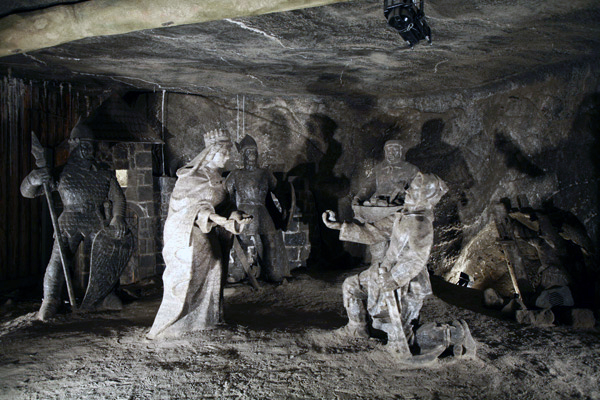
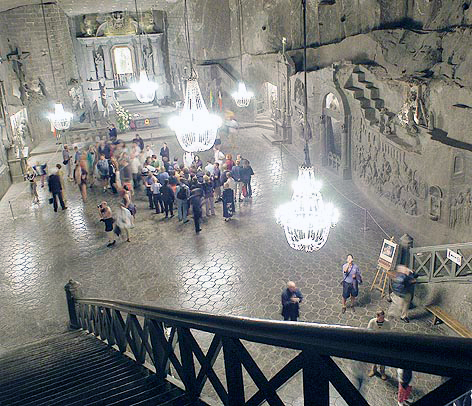
Kinga was also very resourceful and she has great merits for the economics of the country, who became her homeland. In 1247 she went to Hungary. She brought from there to Poland miners from the royal salt mines of Maramaros. They launched in Bochnia and Wieliczka salt mines, which became the first for the district of Cracow, and then for the whole Poland a huge wealth. For several centuries extraction and sale of salt brought income, which accounted 1/3 or even half of the state budget and the base of its economic power.
Thanks her dower to a large extent was rebuilt Cracow and the whole ducal provice. And Sandomierz and Cracow also owes one's urban layout both thanks Bolesław and Kinga. She the same watched over the development of trade and craft. In exchange for a huge dowry, which she brought to the marriage with Bolesław, she received in 1257 The Land Sądecka. She brought there german and magyar settlers, thereby contributing to the economic development these areas. One of her biographers has called her saint and a great landlady the Earth Sądecka. In the same year took place on location of Cracow.
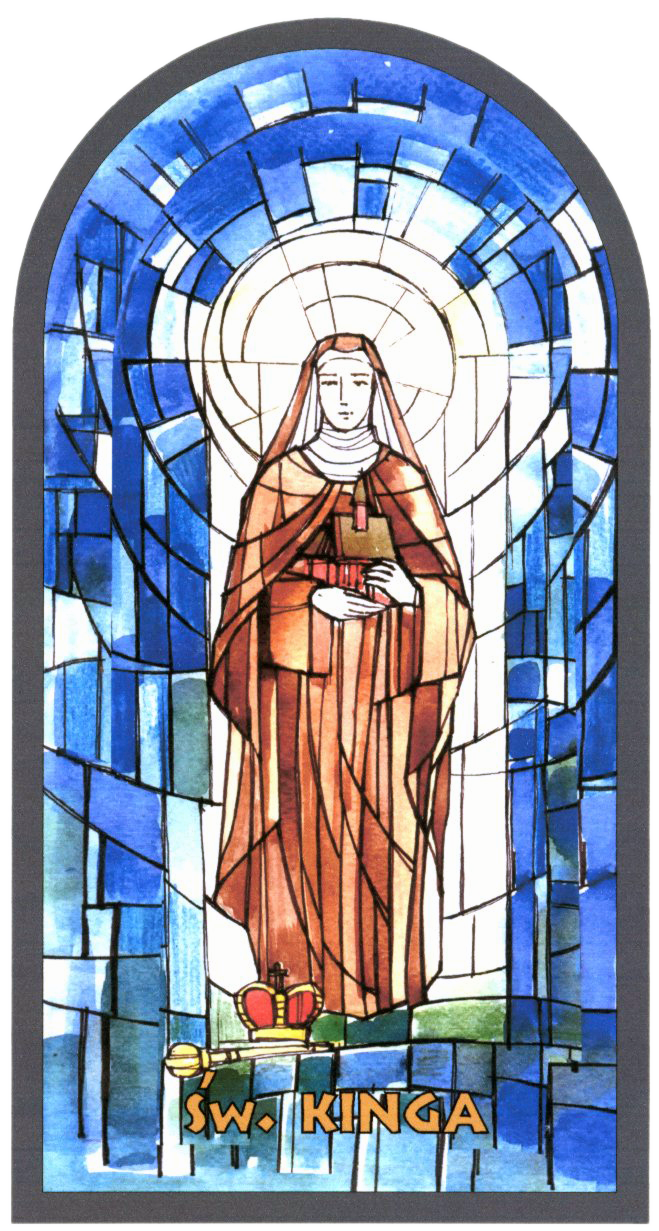
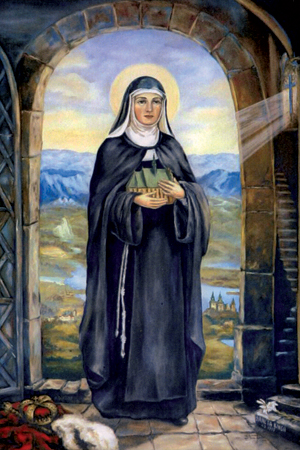
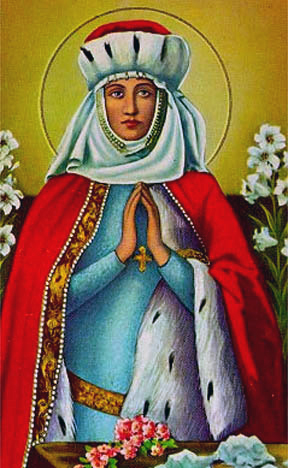
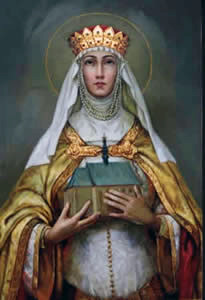
There are also her huge merits for the culture, particulary religious. In the convent of Poor Clares in Stary Sącz first time were sung songs and psalms in polish. Here also most likely arose song "The Mother of God". Kinga with her husband brought to Poland friars (i.a. Franciscans, Cisterians) and she endowed them. She created for them a number of ecclesiastical and monastic foundations, thanks which the friars could lead not only pastoral activites, but also developed the spiritual and material culture. Strengthened the Church assured the State the organization administration and a minimum of education. And monasteries became centers of culture and they propagated technical achievements, even in the culture of the agrarian.
Kinga also assisted her husband in politics and especially in disputes and dynastic conflicts, that have undermined the foundations of Poland. The Country still and so was weakened the same the breakdown of the districts lasting up to their nuptials untill a hundred years. She showed diplomatic skill and determination when Leszek the Black, successor after her husband on the cracowian throne, he wanted to take away her the Earth Sądecka and questioned the foundation of Poor Clares in Stary Sącz. Finally she managed to finish the dispute amicably and she gave back him the Earh Biecka and the Earth of Nowy Korczyn.
In 1271, for eight years before his death, together with Kinga Duke Bolesław made, called perhaps for this reason the Bashful, in the Franciscan Church in Cracow a vow of chastity. Undoubtedly he was a religious man and loved his wife so great love. He had already resigned to that leave no child. Kinga from the beginning of the marriage preserved a celibate and she insisted, that they both made a vow of chastity. Medieval ideal of human, who devotes himself to God, fully justified such sacrifices. Contemporary religious patterns and mood of the era favored penitential gestures and fervent religiosity. New trends, which introduced in the life of Christian Europe new religious Orders aimed at religious revival. Wise Kinga not only understood and accepted but she the same gave an example their realisation .
In 1279 after the death of her husband left Cracow and she led to the effect the foundation of the monastery of Poor Clares in Stary Sącz, yet commenced after a further invasion of the Tatars 1259-1260. Moved there some sisters from Skała and Olkusz. She lived among them as a simple sister. She carried water and wood, she took care of the eldery and sick sisters. To the end of life she hasn't accepted dignity of prioress or abbess. Her practises of penance aroused of general admiration of others sisters. Here together with the sisters Kinga survived yet another invasion of Tatars in late 1287 and in 1288 years. She died in the odor of sanctity 24 July in 1292. She was loved for her holiness, goodness and kindness and also for the devotion her husband for the good of the country. She was surrounded by devout people Sącz region and salt miners in Bochna and in Wieliczka not only a common respect and a halo of sanctity, but also a wreath of beautiful legends. Her grave already after the death attracted crowds of pilgrims.
Three centuries later in 1592 at the request of King Sigismund III Vasa and Bishop of Cracow Marcin Szyszkowski, her relics were moved to Cracow. A little earlier also Bishop of Cracow Bernard Maciejowski suffered healing miracle. In 1628 was initiated beatification process of Kinga. Permission to cult in Poland gave after numerous supplications and after the personal intercession of the King John III Sobieski two centuries later, in 1790 Pope Alexander VIII. Efforts for the canonization began in 1742 interrupted the partitions. Canonized her finally the consecutive two centuries later John Paul II, during his last pilgrimage to his Fatherland, 16 June in 1999 in Stary Sącz. Saint Kinga is the patroness of the three nations: hungarian, polish and slovak, the diocese of Tarnów, and also the salt miners, especially in Bochna and Wieliczka. Special sanctum dedicated for her are: Poor Clares monastery in Stary Sącz and the chapel of salt in Wieliczka in the basement of the salt mine. The same Saint stands among unusual polish rulers, in a number of her great kings, princies and other persons such as: Mieszko I, Kazimierz the Restorer, St. Jadwiga Silesian and St. Jadwiga the Queen, blessed Salomea and blessed Jolanta, St. Kazimierz the Prince, John III Sobieski, Maria Curie-Skłodowska. They are very well-deserved for Church and Fatherland. Skillfully the managed to combine prudence of the rulers and the care for peoples and temporal kingdom with christian concern for the sanctity and salvation.
In memory of her life and holiness, in the so-called dies natalis, that is 24 July we pray: God, You gave to St.Kinga generous blessing and You preserved her as a virgin even in marriage. Give through her intercession, in order to through purity of life we always persist with You. Amen."
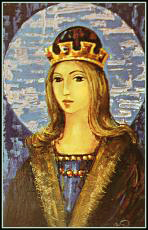
"It is a name derived from the Hungarian form - Cunegonde (Kunegunda). It belonged inter alia to the cracowian princess, and a daughter of the hungarian king. She came into the world in March 1234 years as third then daughter of Bela IV and Maria Laskaris of Byzantium. We little know about her residence on the father's manor. We find more informations about her, when she is brought to Poland in 1239. What were the reasons for bringing such young Kinga to the country? Poland was broken in small principalities. Young 13-year-old ruler Bolesław had to have a mighty guardian. His gaze fell on the King of Hungary. Others were reasons of Bela IV. He knew, that it was necessary to unite Eastern Europe, to oppose the Mongols. And so arose the thought of gaining Bolesław for five-year-old Kinga. The meeting of the future spouses took place in Wojnicz. A first marriage contract was included here. For Bolesław the most important was, that gained an ally in Hungary, and companion in life Kinga. Kinga brought for her husband a rich dowry, who helped rebuild the country, and thus she became "spiritual mother" of rebirth and renewal of our Fatherland, which experienced then a political and economic crisis.
Kinga's first years of residence were years of wandering, full of difficulty and anxiety. Continuous change of residence (Tatar invasions), meeting different people and experiencing ever new sensations left a lasting impression in the mind and heart of Kinga and it has become a rich repository of experiences . Kinga was surrounded on the manor by dignitaries lay and religious. They exerted a positive influence on her upbringing. Her personality was shaped by two women close to her: mother of Bolesław Duchess Grzymisława and his older sister Salomea (later blessed). They have become not only her teachers, but her confidante. Thanks them Kinga met the spirit of Franciscan, what then was reflected in her proceedings for the poor. Heared stories about St.Clare and Francisco squeezed out on her soul an indelible mark and they had become for her a clue of conduct. Brought up such patterns she began work on herself, to destroy the earthly inclinations in herself, supress the senses and to please God. On the royal court she also learned to write, read, learned the Latin and the basic truths of the Christian faith, the life of her ancestors and her husband. She also dealt according to the then fashion of embroidering the chasubles and other ecclesiastical vestments. When Kinga has about 13 years, and Bolesław 21 wedding ceremonies are held. During the wedding fun often goes into the quiet place, to recommend the future of her virginity to Christ. Because under the influence of devotion to the holy mens and women, for whose virginity had the most importance, born in her the thought to follow in their footsteps. To preserve in this provision, asks God for help and keeps a fast for this intention. Now she spends much time in prayer. She meets with Christ in her home chapel, to which she came a few times during the day. She begins to practise in the night vigil and refusing herself the various pleasures.
But staring at the sky she didn't forget, that she's co-governor of the Principality of Cracow and Sandomierz. She suggested to her husband the thoughts and the revelant provisions in the most important matters. She could do so by intelligence, energy, and above all thanks a religious worldview. She watched, that the ratio of the prince to serfs was fair and combined with an understanding of their needs. She sometimes the same was involved in court causes, to protect widows, orphans and the poor. She thought, that help provided to needy is help for same Christ. Kinga choosing the path of purity tried to be the mother for the nation. She supported the Duchy financially. She brought a huge dowry to her husband in the amount of 40 thousands fines, which was partly designed to fight the Tatars and reconstruction of the country of war damages. Thanks her funds was rebuilt Cracow destroyed through twice the awful invasion of Tatars. She bestowed also churches, funded the monasteries, assumed shelters for old and sick. Hojność Kingi wyrażała się także w opiece, which she surrounded the lonely, mothers expecting baby. She had a gift of winning people over, she also distinguished herself so-called good approach. She didn't flinched to talk with women of easy virtue, her influence straightening their crooked paths of life. She indirectly contributed to the canonization of bishop Stanislaus. And when brought to the country of his relics, własnoręcznie obmyła je winem and she decomposed to the precious reliquaries. Uderzającą cechą The striking feature of Kinga was a great decisiveness, definetly, perseverance, and even a great tenacity in pursuit of aim. This is certitude of lady accustomed to meet all her orders and simultaneously the saint, not caring for consideration and approbation of the people.
KINGA BRINGING "BREAD AND SALT"
She learned the people to cultivate the land, within the reform of royal estates she exempted the population of villages from a tribute and servitude. She initiated a village council with a village leader. She learned the people extract salt from the earth, giving rise to the first mines in Bochna and Wieliczka. She understood very well, that a nation can't develop own culture without own language, she therefore solicited about an extensive use of Polish language in church services of the monastery founded by her in Stary Sącz, to which she joined after her husband's death, which occured in December of 1279 years. Thanks her efforts have been translated into Polish Psalter of David. Aleksander Bruckner wrote about her, that "At Kinga's leadership began to remove from Poland the gloom covering the country". Kinga has been an advocate of Polish culture in the main part by Christ, in whose she believed deeply. He through Evangel and the grace destroys the walls separating the people of different races and nations. In a monastery in Stary Sącz she stayed 12 years. In the retainde legal document from 1280 year Kinga for the last time was named "domina" - lady, now it is said, that she's the sister of the Order of St.Francis. All the time of stay in the monastery God didn't spare her suffering. A serious illness riveted her to bed for 10 months. All the suffering she bears peacefully and with the cheerfulness. Help for her is a daily Mass celebrated in her cell. When the suffering subside, she has enough strength, to sew garments for the sick, poor and orphans. Kinga sensing the approaching end is calling the nuns and in their presence speaks her testament. She admonishes nuns, to trust God, to bestow Him the hope, and treat each other with kindness and understanding. Soon after she dies. It's 24 July 1292 years. Funeral ceremonies are held in Stary Sącz. She was buried under the floor of the convent chapel. Performed miracles through her intercession caused, that soon after her death her relics were translated so-called translatio corporis, were prepared precious reliquaries. In connection with the dissolution of the monastery of Poor Clares relics have been exported from Stary Sącz in 1782 years. Austrian officials deported the head, arm and a coffin with the relics and robbed them of precious ornaments. And after some time the relics were returned to Stary Sącz. Beatified her after long efforts 11 June 1690 years. Pope Alexander VIII day her dedicated announced 24 July, and Benedykt XIII awarded her the title of patroness of Polish and Lithuanian. She's also the patroness of miners of Bochnia and Wieliczka. Kinga was canonized by pope John Paul II in the day 16 June 1999 years in Stary Sącz."
"Like the discovery of rock salt in Bochnia and Wieliczka was enveloped the beautiful legend associated with the figure of St.Kinga, also double legend concerns the fate of ring, which St. Kinga threw for a mark of adoption the property bestowed her by father king Bela IV the mine in Marmarosz Sziget, and which it the ring was miraculously in the first lump of salt excavated in Bochna and in Wieliczka.
There are two similar legends concerning of the ring: the version of Wieliczka and the version of Bochnia. One of them "says, that during the time, when to Poland had come St.Kinga as a future spouse of the Prince of Cracow-Sandomierz Bolesław, both Bochnia and Wieliczka were famous already for its brewhouse. Over the years the serum salt in sources was more and more exhausted. Local people dug wells in different locations, seeking new sources of salt, but instead of the source of slat, encountered on clay, sand and fresh water. St.Kinga once came to Bochnia, she saw the worry and the futile efforts of residents Bochnia, associated with the search for sources of salt. Duchess Kinga on result the inner voice set one's sights on garden of one cobbler. She wanted to buy this garden, but the shoemaker from respect for the Princess gave her garden on the property. In this garden St.Kinga instructed to dig a well, in which dug salt, and when mined the first block of salt, St.Kinga recognized in it located her ring, which she threw to the mine in Marmarosz Sziget in Hungary. She instructed to pick the ring without breaking a lump of salt. A lump of salt she took to the castle in Cracow, and ring with the consent of her husband she offered to miners, who extracted it from the mineshaft. It was a ring of pure gold. Miner Klemens, who became the owner of the ring wondered a long time with his wife Margaret, how to secure such an expensive ring from the eyes of people jealous, who could deprive them of this treasure. Finally happy with the treasury held, and also apperhensive for his safety, that since they have at home two gold and two silver coins, that they may transferred it along with the ring obtained from St.Kinga to a goldsmith in Cracow, who will prepare from an alloy the six wedding rings with blue eye for their six beautiful daughters. In this way nobody will be able to rob them of the rich and so much a memorial gift. As they planned, so it was. In a short time on the fingers of their daughters appeared gold wedding rings with blue eye. Parents instructed their daughters, so that in the future convey this great treasure their children"In years, when historical sources indicate the discovery of rock salt in Bochnia and in Wieliczka /1251 - 1252/ princely pair Bolesław and Kinga stayed in Nowe Miasto Korczyn. In the legends of the ring of St.Kinga we see conflict with the historical facts, with which creators of their legends reckoned not much. According to the oldest biograhies of St.Kinga from witness testimonies in the beatification processes ... St.Kinga didn't become attached to the goods of this world, therefore no major fluctuations she offered needy material resources. St.Kinga characterized by a great sense of responsibility for the spiritual and material conditions of her subordinates. It's known how generously she bestowed people in need, poor, widows, orphans, sick people, poor marriageable girls. She personally appeared in courts in defense of the oppressed, who couldn't afford to enlist judges through rich gifts. The legend about ring this truth about the goodness of St.Kinga emphasize and points to the generous hand of the Princess and great concern for the welfare of serfs in the Duchy Cracow-Sandomierz, desire for the good for the whole Poland, for all its inhabitants.